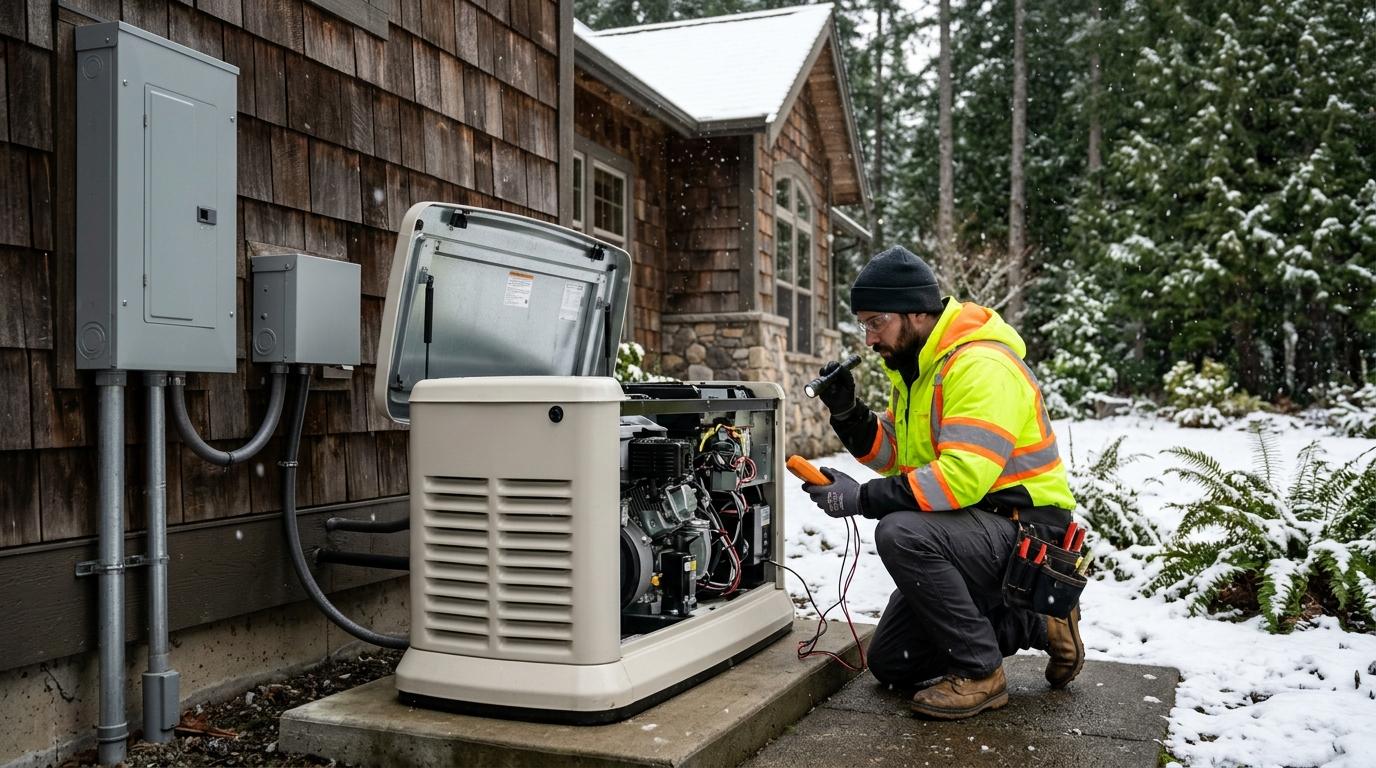
Determine the exact generator size your home requires with our guide to starting watts, deep well pumps, winter heat pumps, and smart load management.
To answer the question of what size generator do I need for my house, you must calculate the total running watts of your appliances plus the highest starting watts of your largest motor. Most Inland Northwest homes require a 7–10 kW unit for essential circuits, or an 18–24 kW standby generator with smart load management for whole-home backup.
Choosing the correct backup power system is about more than just adding up lightbulbs. Whether you are weathering a severe winter ice storm or a summer wildfire power shutoff, having reliable electricity is a matter of safety and property protection. A unit that is too small will trip breakers and potentially damage expensive appliance motors, while wildly oversizing your equipment wastes money and fuel.
Key Takeaways for Generator Sizing
- Starting watts matter most: Motors in HVAC systems and well pumps require up to three times their normal running wattage just to start.
- Rural properties need more surge capacity: Deep-well submersible pumps require significant power to overcome motor startup inertia.
- Winter heating changes the math: Cold-climate heat pumps rely on electric auxiliary heat strips during sub-zero temperatures, which draw massive amounts of power.
- Smart management is code-required: To run a modern all-electric home on a standard standby generator, the National Electrical Code requires automatic load shedding.
What is the Difference Between Starting Watts and Running Watts?
The most common mistake homeowners make when using a basic generator sizing calculator is confusing running watts with starting watts (also known as surge watts). Understanding this distinction is the foundation of properly sizing any backup power system.
Running watts represent the continuous power required to keep an appliance operating normally. For example, a standard refrigerator might need 700 running watts to keep your food cold. Starting watts represent the brief, massive spike in electrical demand required to start an electric motor from a standstill. That same refrigerator might require 2,100 starting watts for the first two to three seconds the compressor kicks on.
If you size your generator based solely on running watts, the system will overload and shut down the moment a large motor tries to start. When calculating how many kW generator to run a house, you must add up the running watts of all the items you want to power simultaneously, and then add the single highest starting wattage requirement among them.
Essential Backup vs. Whole-Home Power
Before looking at specific sizes, you must decide whether you want to power a few critical circuits or back up your entire electrical panel. National guides often base sizing on home square footage, which is a flawed rule of thumb. A 3,000-square-foot home with gas heating and city water uses far less electricity during an outage than a 1,500-square-foot rural home with an electric furnace and a deep well pump.
| Coverage Type | Typical Size Required | What It Powers |
|---|---|---|
| Essential Circuits Only | 7 kW – 10 kW | Refrigerator, kitchen lights, Wi-Fi router, microwave, gas furnace blower fan, dedicated medical devices. |
| Managed Whole-Home | 14 kW – 24 kW | All essential circuits plus central air conditioning, well pumps, electric water heaters, and electric ranges (managed via load shedding). |
| Unmanaged Whole-Home | 30 kW – 38+ kW | Industrial-sized units capable of running all heavy 240V appliances simultaneously without smart power management. |
For most residential applications, aiming for a managed whole-home system offers the best balance of comfort, safety, and efficiency.
What Size Generator Do I Need For My House With a Well Pump?
Unlike homes in municipal Spokane or Coeur d'Alene, properties in outlying rural communities rely heavily on deep private wells. If you lose power, you lose running water for drinking, livestock, and sanitation. Calculating the generator size for well pump operations is critical.
Deep-set submersible pumps (often 300 to 600 feet deep) use 240V motors that require immense starting surge power, known as Locked Rotor Amps (LRA). National sizing guides often cite standard "sump pumps" at 700 watts, completely failing to account for rural well requirements.
- 0.75 HP Submersible Pump: Requires approximately 1,500 running watts but demands 3,000 to 4,500 starting surge watts.
- 1.5 HP Submersible Pump: Requires approximately 2,200 running watts but demands 6,000 to 8,500 starting surge watts.
- 2 to 3 HP Deep-Well Pumps: Can require 8,000 to 12,000 surge watts solely to overcome motor startup inertia.
If you live in a rural area, your well pump will likely dictate the minimum baseline size of your backup power system.
Can a Generator Run a Heat Pump in the Winter?
The Inland Northwest experiences sub-zero winter temperatures. Many modern homes utilize inverter-driven cold-climate heat pumps. While a heat pump's compressor is highly efficient and relatively easy to power, the region's extreme cold triggers a hidden power draw: electric auxiliary heat strips.
Resistive supplemental heat strips inside the air handler activate when the heat pump cannot extract enough warmth from the freezing outside air. These strips draw approximately 3,412 BTUs per kW. A typical 10 kW heat strip bank pulls around 41.6 amps at 240V continuously (10,000 watts) purely for auxiliary heat. This demand alone can double the power requirement of an average home.
So, can a generator run a heat pump? Yes, but if you rely on electric backup heat, a standard 14 kW or 18 kW standby generator will immediately overload when those heat strips activate unless the system is equipped with intelligent power management.
How Does a Load Shedding Generator Work?
Many homeowners wonder how a 22 kW generator can possibly run a 200 amp service generator sizing scenario, especially when the home has a heat pump, an electric water heater, and a well pump. The answer is automatic load shedding.
Instead of buying a massive, expensive 38 kW liquid-cooled generator to handle the rare event where every appliance turns on at once, a load shedding generator uses smart management modules. These modules are wired into your high-draw 240V circuits.
If the generator approaches its maximum capacity, the load shedding system temporarily pauses lower-priority heavy loads. For example, if your heat pump and well pump are running, the system might temporarily lock out the electric water heater. Once the well pump shuts off, power is automatically restored to the water heater. You never notice a difference inside the house, but the generator is protected from overloading.
This is not just a good idea; it is often required by code. Under the National Electrical Code (NEC) Article 702.4(B), when automatic transfer switches are used, the generator must either be sized to carry the full calculated load of the panel, or the installation must utilize an automated load management system.
Safety, Permitting, and Grid Protection
Electrical work is dangerous, and backup power introduces unique hazards. The Electrical Safety Foundation International (ESFI) notes that improper generator use can lead to carbon monoxide poisoning or electrical fires. Furthermore, connecting a generator to your home without a proper transfer switch can result in "backfeeding." Backfeeding sends high-voltage electricity back down the utility lines, endangering the lives of utility workers trying to restore the grid.
Because of these risks, generator and transfer switch installations require dedicated electrical permits and physical inspections. In Washington, these are handled through the Department of Labor & Industries (L&I), while in Idaho, they fall under the Division of Occupational and Professional Licenses (DOPL). A licensed electrician will ensure your system is properly interlocked, grounded, and compliant with local amendments.
Local Generator Sizing and Installation from KT Electrical
KT Electrical Contractors is a licensed electrical contractor based in Spokane Valley, WA, providing whole-house generator installations to homes and businesses in Spokane, Coeur d'Alene, Deer Park, and Rathdrum.
Because we are licensed in both Washington and Idaho, border-area projects do not require two different contractors. We handle residential, commercial, and new construction electrical work entirely in-house. When sizing a generator for your home, our local crews calculate the exact starting watts for your specific HVAC systems and well pumps, design code-compliant load shedding configurations, and pull all necessary L&I or DOPL permits. We understand the Inland Northwest housing stock and local utility requirements, ensuring your backup power system operates safely and passes inspection the first time.
Ready to Secure Your Home's Power?
Determining exactly what size generator do I need for my house requires careful calculation of motor starting loads and a deep understanding of local electrical codes. Do not leave your winter safety to guesswork or generic online calculators.
If you are ready to explore reliable backup power solutions tailored to your property's specific needs, contact KT Electrical Contractors today. Call our office at (509) 953-1186 or request a quote online to schedule a consultation with our licensed electricians.
KT Electrical serves:Electrician in Spokane, WAElectrician in Spokane Valley, WAElectrician in Deer Park, WAElectrician in Coeur d'Alene, IDElectrician in Rathdrum, ID