Keep your home safe and festive this winter. Learn how to calculate circuit loads, prevent GFCI trips in the snow, and safely install outdoor holiday lighting.
To ensure holiday lighting safety tips protect your home this winter, inspect all cords for damage, switch to energy-efficient LED bulbs to prevent circuit overloads, and use only outdoor-rated extension cords. In snowy climates like Spokane, keeping plug connections dry and using weatherproof outlet covers is essential to stop ground faults, nuisance tripping, and potential electrical fires.
Key Takeaways for Christmas Light Safety
- Inspect before you connect: Check all light strings for bare copper, frayed wires, or cracked sockets before plugging them in.
- Do the math: Never exceed 1,440 watts on a standard 15-amp residential circuit to avoid a christmas lights tripping breaker scenario.
- Protect from snowmelt: Freeze-thaw cycles in the Inland Northwest cause moisture to enter connections, which trips sensitive GFCI outlets.
- Use the right cords: Practice proper extension cord safety outdoors by using heavy-duty, outdoor-rated (SJTW/STW) cords with red UL/ETL tags.
- Watch for overhead lines: Maintain at least 10 feet of clearance from overhead service drops when working on ladders.
Inspecting and Preparing Your Decorations
The foundation of christmas light safety begins before the first string touches the roofline. Every year, the National Fire Protection Association (NFPA) reports that U.S. fire departments respond to hundreds of home structure fires started by holiday decorations, with electrical lamp or bulb failures being a leading cause.
Before installing any temporary lighting, lay out all strings and extension cords in a dry, well-lit area. Inspect the wiring for pinched sections, cracked insulation, or exposed bare copper. If a string is damaged, discard it immediately; attempting to tape over frayed wires is a severe fire hazard. Next, verify that the lights and cords are properly rated for their intended use. Extension cords and light strings feature colored safety certification tags (such as UL, ETL, or CSA). A red tag indicates the product is rated for both indoor and outdoor use, while a green tag means the product is strictly for indoor use.
Additionally, the National Electrical Code (NEC) Section 590.5(B) restricts temporary holiday decorative lighting and associated wiring to an installation period of no more than 90 days. Leaving lights up year-round exposes the plastic insulation to excessive ultraviolet light from the sun and extreme temperature fluctuations, which rapidly degrades the wiring and increases the risk of electrical faults.
How Many Christmas Lights on One Circuit?
A common question homeowners ask is how many christmas lights on one circuit they can safely install before overloading the system. The answer depends heavily on whether the display uses traditional incandescent bulbs or modern commercial-grade LEDs, as well as the capacity of the circuit powering the exterior outlets.
Under the NEC Article 210, continuous loads—defined as any electrical load running for three hours or more—should not exceed 80 percent of the circuit's total capacity. For a standard residential 15-amp, 120-volt circuit, the maximum continuous load is 1,440 watts (or 12 amps). For a 20-amp circuit, the limit is 1,920 watts (or 16 amps).
Older historic homes in Spokane often lack dedicated outdoor circuits. Exterior outlets might share a circuit with a garage refrigerator, a basement space heater, or a bathroom GFCI. Plugging a massive holiday light display into a shared circuit guarantees an overload. If you are constantly resetting the panel, professional electrical troubleshooting is necessary to map the circuit and determine the actual load.
Comparing Incandescent and LED Loads
Understanding the mathematical difference between bulb types is crucial for planning a safe display. Traditional C9 incandescent bulbs draw roughly 5 watts each. A single string of 25 bulbs consumes 125 watts. Stringing four of these sets together draws 500 watts. Conversely, commercial-grade LED retrofit bulbs draw approximately 0.6 to 1 watt per bulb, drastically reducing the strain on the electrical panel.
| Bulb Type | Watts per 100 Bulbs | Amps per 100 Bulbs | Max Strings on 15A Circuit (80% Rule) |
|---|---|---|---|
| Traditional C9 Incandescent (5W) | 500 Watts | 4.16 Amps | 2 to 3 Strings (max 288 bulbs) |
| Commercial-Grade LED Retrofit (1W) | 100 Watts | 0.83 Amps | 14 Strings (max 1,440 bulbs) |
Switching to LED lighting not only lowers the electric bill but also practically eliminates the risk of overloading a dedicated breaker, keeping the display safely within the 1,440-watt continuous load limit.
Why Outdoor Christmas Lights Trip GFCI Outlets in Snow
Homeowners in the Inland Northwest frequently struggle with their outdoor christmas lights gfci tripping as soon as the weather turns. Unlike the mild rain on the coast, Spokane and North Idaho experience heavy snowfall followed by sudden chinook winds and freeze-thaw cycles. This unique climate challenge is the primary culprit behind nuisance tripping.
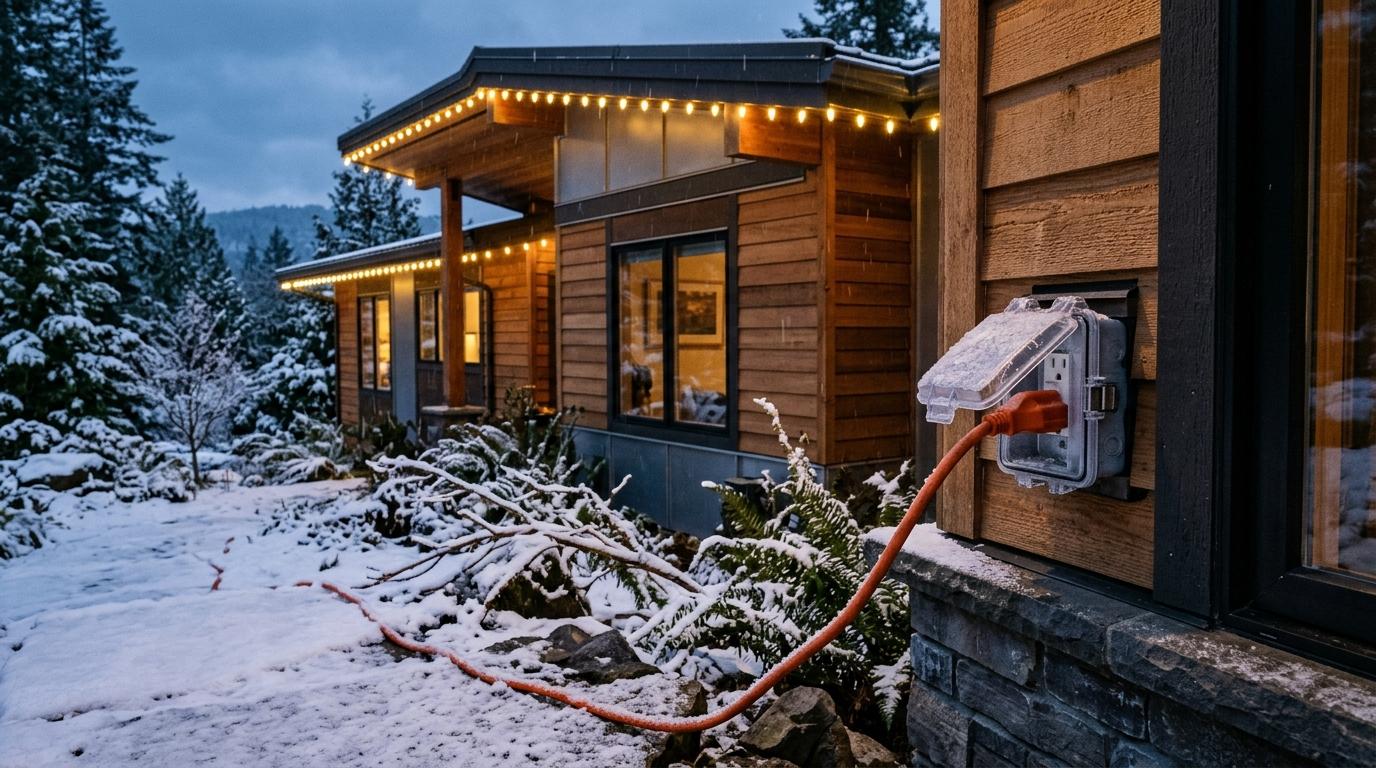
Class A Ground-Fault Circuit-Interrupters (GFCIs) are life-saving devices engineered to trip when they detect a current leakage to ground of just 4 to 6 milliamperes (mA) within roughly 25 milliseconds. When snow accumulates on rooflines, fascia, or directly on extension cord connections resting on the ground, daytime sun or the heat from the bulbs melts the snow. This water seeps into the microscopic gaps between the male and female plug ends. The moisture creates a tiny path for electricity to escape to the ground, registering as a 4-6 mA leak, which instantly trips the GFCI.
To practice proper extension cord safety outdoors and prevent these ground faults, keep all connections elevated off the soil or concrete. Do not allow connections to sit in gutters or lay flat on shingles where snowmelt pools. Use specialized weatherproof cord gaskets or dielectric grease rated for electrical connections to keep moisture out of the plug ends.
The Importance of Extra-Duty While-In-Use Covers
Another major reason for GFCI trips is outdated exterior receptacle covers. Many older homes still feature flat metal flap covers. When a cord is plugged in, these flaps remain propped open, allowing blowing snow and sleet to bridge the outlet prongs.
NEC Article 406.9(B)(1) mandates that all 15- and 20-amp, 125- and 250-volt receptacles located in wet locations must have an "extra-duty" weatherproof while-in-use cover. These bubble-style covers close completely over the plugged-in cord, protecting the receptacle from driving snow and freeze-thaw melt. Upgrading to these covers is a critical step in modernizing residential electrical systems for winter safety.
Ladder Safety and Avoiding Overhead Power Lines
Electrical safety extends beyond the wires themselves. The Consumer Product Safety Commission (CPSC) estimates that roughly 12,000 to 14,000 emergency department-treated injuries occur each holiday season related to decorating, with falls from ladders making up the vast majority.
When hanging lights along the roofline, always maintain three points of contact on the ladder (two feet and one hand, or two hands and one foot). Ensure the ladder is placed on level, stable ground, which can be difficult when snow and ice have already accumulated near the foundation.
Furthermore, local utility providers like Avista Utilities and Kootenai Electric Cooperative warn homeowners about overhead service entry mastheads. Many older neighborhoods, such as Spokane's South Hill or older sections of Coeur d'Alene, feature low overhead power drops entering near roof edges. Using an aluminum extension ladder near these drops is incredibly dangerous. Always keep yourself, your ladder, and your light strings at least 10 feet away from any overhead service drop wires to prevent fatal electrocution.
Reliable Exterior Lighting Upgrades in Spokane from KT Electrical
KT Electrical Contractors is a licensed electrical contractor based in Spokane Valley, WA, providing exterior lighting upgrades and dedicated outdoor circuits to homes and businesses in Spokane, Spokane Valley, and Coeur d'Alene. Adding dedicated outdoor circuits or upgrading outdated exterior receptacles requires strict adherence to local codes, and doing it right ensures your holiday displays run safely all season.
Because KT Electrical is licensed on both sides of the state line (Washington L&I and Idaho DOPL), border-area projects are handled seamlessly by one contractor. Whether a historic home in Spokane requires a new dedicated 20-amp circuit to stop breakers from tripping, or a commercial property needs extra-duty while-in-use covers installed to protect against driving snow, the residential and commercial teams handle the work in-house. A licensed electrician pulls the necessary permits, ensures the load calculations are accurate, and guarantees the work passes inspection, giving local homeowners peace of mind when plugging in their winter displays.
For more information on upgrading your exterior systems, visit the lighting services page to learn how professional installations improve safety and convenience.
Schedule Your Electrical Upgrades Today
Do not let overloaded circuits, tripped GFCIs, or outdated outdoor outlets ruin your holiday season. If you are planning a large lighting display or simply want to ensure your exterior electrical system is safe for the winter weather, rely on a licensed professional to evaluate your panel and exterior receptacles.
Contact KT Electrical Contractors to ensure your home is equipped to handle the winter load safely. Call (509) 953-1186 or visit the contact page to request a quote for dedicated circuits, weatherproof cover installations, or comprehensive electrical troubleshooting today.
Frequently asked questions
Why do my outdoor Christmas lights keep tripping the GFCI outlet after it snows?
GFCI outlets are designed to trip when they detect a tiny current leak (4 to 6 milliamperes). When snow melts during the day, water seeps into the connections between extension cords and light strings, creating a ground fault that trips the sensitive outlet.
How many strands of Christmas lights can I safely plug into one circuit?
On a standard 15-amp residential circuit, you should not exceed 1,440 watts of continuous load. This allows for about 2 to 3 strings of traditional 5-watt incandescent bulbs, but up to 14 strings of energy-efficient commercial LED retrofit bulbs.
Can outdoor extension cords stay buried under snow and ice?
While outdoor-rated cords (SJTW/STW) can withstand cold temperatures, the connection points where two cords meet should never be buried in snow or submerged in puddles. Keep connections elevated and use weatherproof cord gaskets to prevent moisture intrusion.
How long can you leave temporary holiday lights installed outside?
According to the National Electrical Code (NEC), temporary decorative holiday lighting and associated wiring should be installed for no more than 90 days. Leaving them up longer exposes the wiring to UV damage and extreme weather degradation.
Why do LED Christmas lights trip my breaker in cold temperatures?
LED lights draw very little power, so if they are tripping a main circuit breaker, it usually means the exterior outlet is sharing a circuit with other heavy loads inside the house, such as a garage refrigerator or a space heater.
KT Electrical serves:Electrician in Spokane, WAElectrician in Spokane Valley, WAElectrician in Coeur d'Alene, ID